Verify Your Trading Decisions Before You Act
The best investors aren’t the ones who are right most often. They’re the ones who size correctly, manage risk, and avoid unforced errors — the self-inflicted mistakes that have nothing to do with being wrong about a stock and everything to do with process. A short verification step before each trade is one of the highest-leverage habits you can build, and it costs you nothing but a minute of honesty.
This guide gives you a concrete pre-trade routine: why verification works, a four-point checklist you can run in under a minute, and how to let an AI coach that knows your portfolio pressure-test the trade before you commit. Do it consistently and you won’t win every trade — but you’ll stop losing the ones you never should have taken.
Why verify at all?
In the moment, every trade feels obvious. That feeling is the problem. Conviction is a poor guide precisely because it’s loudest when you’re most emotionally invested — after a stock has run, after a loss you want to recover, after a headline that triggers urgency. A short pause to check your reasoning against your actual portfolio catches the mistakes conviction hides: over-concentration, doubling down on a losing thesis, or adding a position that conflicts with what you already own.
Verification isn’t about talking yourself out of trades. It’s about making sure the trades you take are deliberate. Most portfolios aren’t sunk by the occasional bad call — they’re slowly drained by unforced errors, the same patterns covered in how FinCoach AI helps you avoid the most common trading mistakes. A verification habit is the single most effective defense against repeating them.
A simple pre-trade checklist
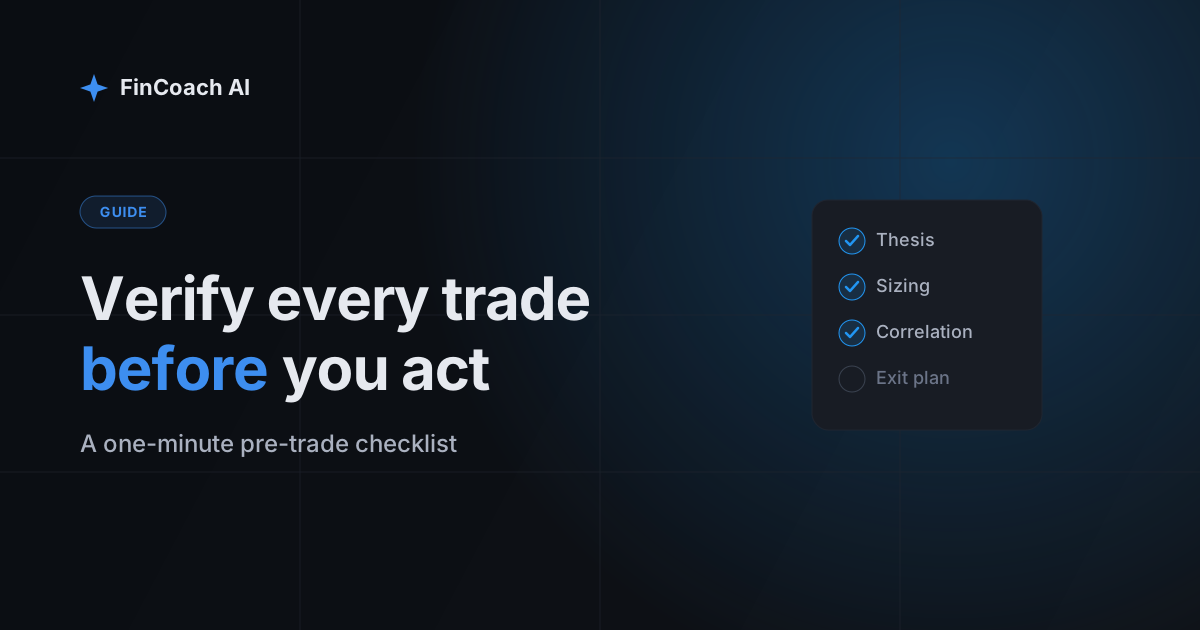
You don’t need a twenty-point framework. Four questions, asked honestly, catch the overwhelming majority of unforced errors:
- Thesis: can you state in one sentence why this trade works — and, just as important, what specifically would prove you wrong?
- Sizing: how much of your portfolio is this position, and what actually happens to your total if it goes to zero?
- Correlation: does this overlap with names you already hold, or is it a genuinely independent bet?
- Exit: where are you wrong, and exactly what will you do when you get there?
If you can’t answer all four cleanly, that’s not a reason to abandon the trade — it’s a signal to slow down and fill the gap. The question people fail most often is the second one. Position sizing, not stock selection, is what separates a survivable mistake from a portfolio-altering one.
Size the position before you fall in love with it
A great idea in the wrong size is a bad trade. Before you place an order, it’s worth grounding the decision in the same math that drives long-term outcomes. The free how much to invest calculator helps you frame position sizes around your income and goals, and the compound interest calculator is a useful reminder of why protecting your capital base matters more than any single winner. You’ll find the full set on the calculators page.
The habit to build is simple: decide your size as a percentage of your portfolio before you look at the potential upside. Upside is seductive and will always argue for “just a little more.” Deciding size first keeps that voice out of the room.
Let the AI coach pressure-test it
FinCoach AI’s coach already knows your portfolio, which makes it the ideal devil’s advocate. Before you place a trade, ask it the questions you’re tempted to skip: what risks am I underweighting here, how does this change my concentration, and is the timing consistent with the patterns in my own history? Because it answers with your real positions, the feedback is specific — it can tell you that a new tech name would push your sector exposure past a level you were uncomfortable with last month.
A second, dispassionate opinion is exactly what emotion-driven decisions lack. The coach won’t tell you whether a stock will go up — nothing honestly can — but it will show you how the trade fits the portfolio you actually hold, which is the part your conviction is least equipped to judge. If you’re new to the app, the getting started guide shows how to import your statement so the coach has full context.
A minute of verification rarely costs you a good trade. It routinely saves you from a bad one.
Verifying an add versus a new position
Not all trades carry the same risk, and verification should adapt. Adding to a position you already hold feels safe — you know the story, you’re already comfortable — but it’s precisely where concentration builds up unnoticed. The question to force is: after this add, what percentage of my portfolio is this single name or theme, and am I comfortable with that number in a bad month? An add that pushes a position from 5% to 12% is a different decision than it feels like in the moment.
A genuinely new position deserves the opposite scrutiny: is it actually independent of what I own, or is it the same macro bet in a new ticker? This is where a coach that knows your book earns its keep — it can tell you the new name correlates with three positions you already hold, turning what looked like diversification into doubling down. The behavioral side of this is covered in depth in how to avoid the most common trading mistakes.
When verification says no
Sometimes the checklist returns an uncomfortable answer: you can’t state the thesis in a sentence, the size is too large, or the trade overlaps everything you own. That’s not a failure of the process — that’s the process working. The hardest and most valuable outcome of verification is the trade you don’t take, because it’s invisible. You never see the loss you avoided, so it never feels like a win. But those avoided losses are exactly where the edge lives.
Learning to sit with “no” is a skill. It helps to reframe it: passing on a weak trade isn’t missing out, it’s preserving capital and attention for a better one. The market offers a nearly infinite number of opportunities; your capital and focus are the scarce resources. Verification is how you allocate them to the trades that actually deserve them.
Close the loop with a post-trade review
Verification happens before the trade; learning happens after it. Once a position is closed, a short post-trade review turns a single outcome into a lasting lesson. Ask: did I follow my plan, or did I improvise? Was the result driven by my process or by luck? A winner reached by breaking your own rules is a dangerous teacher — it rewards exactly the behavior you’re trying to eliminate.
FinCoach AI makes this loop concrete, because it holds your history. Reviewing your closed trades against the plans you set surfaces whether your process is actually improving or whether you’re just riding variance. Over time, that feedback is what converts a checklist into instinct — the point at which verification stops feeling like a chore and starts feeling like how you naturally think about risk.
What verification catches that charts don’t
Technical and fundamental analysis tell you about the stock. Verification tells you about the trade — the intersection of that stock and your specific portfolio, risk tolerance, and history. Those are different questions, and the second is the one that actually determines your outcome.
- A “high-conviction buy” that would triple your exposure to a single theme is a concentration decision, not just a stock pick.
- A perfectly good company bought at the top of a FOMO run is a timing error the chart won’t warn you about.
- Averaging down can be discipline or it can be the sunk-cost trap — verification forces you to say which, out loud.
None of these show up on a price chart. They show up only when you check the trade against the portfolio you already hold — which is precisely what a verification step, and a coach that knows your book, are built to do.
Common objections — answered
Two objections come up every time verification is suggested, and both are worth addressing honestly. The first is “I don’t have time.” But the checklist is four questions, and the coach answers in seconds — it’s a one-minute step guarding a decision that can move your portfolio by thousands. The math is lopsided in verification’s favor. If a minute feels like too much friction for a trade, that itself is a useful signal about how impulsive the trade might be.
The second is “verification kills my edge — I’ll miss fast moves.” In practice, the trades you miss by pausing a minute are overwhelmingly the FOMO chases and impulsive adds that hurt you anyway. Genuine edge doesn’t evaporate in sixty seconds; if it does, it was noise. The disciplined investors who verify aren’t slower — they’re simply not spending capital on the low-quality trades that create the illusion of activity.
- “It slows me down.” It slows down bad trades far more than good ones — which is the point.
- “I already know my portfolio.” Knowing and checking are different; the check catches the drift you stopped noticing.
- “The market won’t wait.” The market offers endless setups; your capital is the scarce resource worth protecting.
Underneath both objections is the same truth: verification only feels costly because its benefits are invisible. The losses you avoid never show up on your statement. But they’re real, and over a year they compound into the difference between disciplined investing and expensive guessing.
Turn verification into a habit
The goal isn’t to second-guess every decision into paralysis. It’s to make deliberateness automatic, so that running the checklist and asking the coach becomes as routine as placing the order itself. Attach it to a trigger you already have — the moment before you type a ticker into the order box — and it will stick.
Over a year, avoiding a handful of unforced errors often matters more than any single winner. That’s the quiet math of investing: you don’t need to be brilliant, you need to stop beating yourself. A one-minute verification habit, run consistently, is how ordinary investors capture that edge.
As always, this is educational information rather than financial advice, and no process removes the risk that comes with investing, including the loss of capital. What verification removes is the avoidable part — and over time, that’s a lot.
Pressure-test your next trade with an AI coach that knows your portfolio. Launch the app.
Launch appThis article is for educational and informational purposes only and is not financial, investment, tax or legal advice. FinCoach AI is not a broker or registered investment adviser. Investing involves risk, including the possible loss of capital. Do your own research and consider a licensed professional before acting. See our Terms.